
How to Select Countertop Edges for Your Kitchen

A countertop edge may occupy only a few inches of your kitchen, but it is one of the details you will see and touch every day. It affects how the countertop feels when you lean against an island, how easily crumbs wipe away, and whether the finished room reads clean and modern or more traditional. Knowing how to select countertop edges starts with looking beyond the showroom sample and considering your household, cabinet style, countertop material, and budget together.
For Phoenix-area kitchen remodels, this choice also needs to work with real life: busy family mornings, frequent entertaining, bright natural light, and the hard-working island that often becomes the center of the home. The right profile should look intentional without making cleaning or long-term maintenance harder than it needs to be.
Start With the Kitchen’s Overall Style
Countertop edges should support the cabinet door style rather than compete with it. A crisp edge can reinforce the simple lines of a shaker or slab-front kitchen. A shaped profile can add the finishing detail that traditional raised-panel cabinets and decorative hardware often need.
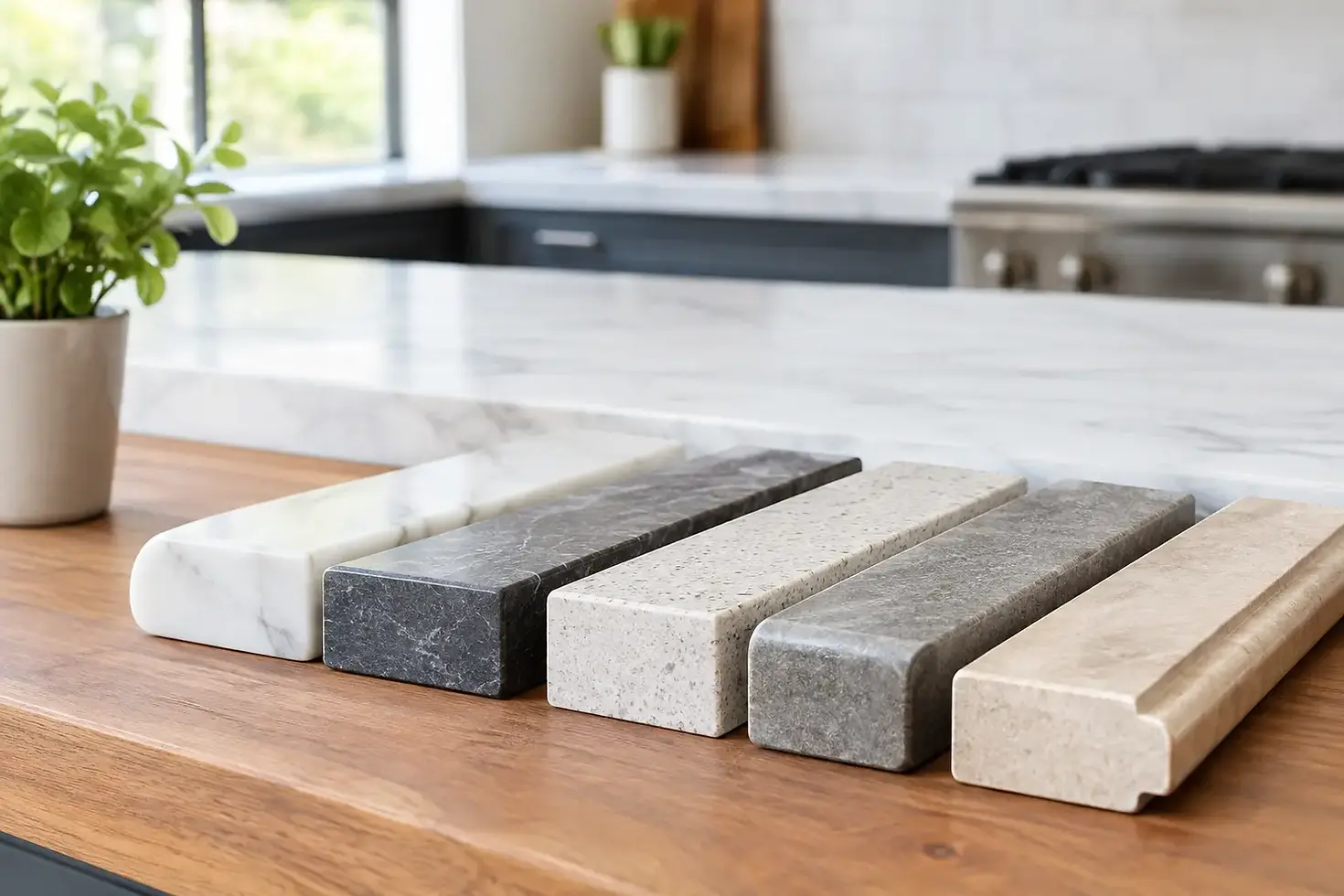
Square eased edges are among the most versatile choices. They appear straight and contemporary from a distance, but the top corner is lightly softened to remove the sharpness. This profile works well with quartz, granite, and many solid-surface materials. It is a practical fit for homeowners who want a polished kitchen without a heavily decorative look.
A pencil edge has a slightly more rounded corner and gives the countertop a softer appearance. It still feels current, but it is less angular than a square eased edge. This is often a strong middle-ground choice for transitional kitchens, especially when homeowners want clean cabinetry with warmer wood tones, textured tile, or more classic lighting.
Bullnose edges are fully rounded or gently curved. They create a softer, more traditional appearance and can be more forgiving in kitchens with young children. Full bullnose profiles remain popular in certain classic designs, though they can make a countertop appear thicker and more substantial than a simple eased edge.
Beveled and ogee edges add visible detail. A bevel uses an angled cut along the edge, while an ogee profile has a more ornamental S-shaped curve. Both can complement formal kitchens, but they are not automatically the best upgrade. On a simple cabinet design, a detailed edge may feel out of place. On the right cabinetry, crown molding, and hardware combination, it can provide a refined custom look.
How to Select Countertop Edges by Material
The material matters because not every profile is available or advisable for every countertop. Fabricators evaluate thickness, slab pattern, edge strength, and the way a specific material cuts before recommending an option.
Quartz is consistent, durable, and well suited to many standard profiles, including eased, pencil, beveled, and bullnose edges. Its clean, engineered look often pairs naturally with a simple eased profile. For a bolder style, a mitered edge can create the appearance of a thicker countertop by joining two pieces at a sharp corner. This works especially well on islands and waterfall ends, but it requires precise fabrication and installation.
Granite offers natural movement and variation, which can make a shaped edge especially attractive. It also accommodates many profile options. Still, a very elaborate edge can distract from dramatic veining or speckling in the stone. If the granite itself has a lot of visual activity, a simpler edge usually lets the material remain the focal point.
Marble and quartzite bring distinctive natural character, but they also deserve careful planning. Marble is softer and more prone to etching than quartz, so a profile that avoids a fragile sharp corner can be a practical choice. Quartzite is generally harder, yet its natural veining should be considered when deciding how much decorative detail belongs at the edge.
Laminate countertops have their own edge options, often including wrapped, beveled, or postformed profiles. They can deliver strong value and a clean finished look, though they will not duplicate every stone profile. A good design plan works with the material instead of trying to force it to mimic a higher-cost slab.
Think About Safety, Cleanup, and Daily Use
A countertop profile should fit the way your household uses the room. The sharpest-looking edge is not always the most comfortable or resilient choice.
A true square edge can look striking, but it may be more vulnerable to chipping at exposed corners, particularly around an island or a high-traffic peninsula. A lightly eased or pencil edge retains the modern look while making those corners more comfortable and less harsh. This is one reason these profiles are popular for active kitchens.
Rounded edges can be a sensible choice for families with small children or homeowners who regularly host guests around the island. They soften the impact of an accidental bump and make a seating overhang feel more comfortable against forearms and elbows.
Cleanup is another practical consideration. Decorative grooves and deep curves can collect crumbs, dust, and residue, particularly near the cooktop or sink. They are not difficult to maintain, but they do require more attention than a simple eased edge. If your priority is a low-maintenance kitchen, a straightforward profile is usually the better investment.
Also consider where the edge will be used. The perimeter counter along a wall may not need the same treatment as an island. A kitchen can use a simple edge around the room and reserve a thicker mitered detail or waterfall panel for the island, where it will have the most visual impact.
Match the Edge to Countertop Thickness
Most countertop slabs are commonly fabricated at a standard thickness, but the edge profile can change how substantial the finished surface looks. A simple eased edge keeps the countertop visually light. A laminated or mitered edge can make it appear much thicker, often creating a more dramatic custom feel.
Thickness should relate to cabinet proportions. Streamlined flat-panel cabinets often look best with a clean standard-thickness edge or a deliberate mitered statement. More traditional cabinets may carry a thicker-looking top or shaped edge comfortably because the door profiles and trim have more visual detail.
Do not select a thick edge only because it looks impressive in a showroom. In a smaller kitchen, a heavy profile can overpower the cabinetry and make the room feel busier. In a large open kitchen with a substantial island, that same detail may provide the balance the space needs.
Budget for Fabrication, Not Just the Slab
Countertop quotes are shaped by more than material and square footage. Edge fabrication, seams, cutouts, backsplash treatment, installation access, and special details all affect the final price. Standard eased edges are generally the most cost-effective because they require less labor. More complex profiles, laminated edges, and mitered corners require additional fabrication time and material.
This does not mean you need to avoid custom details. It means the best value comes from putting them where they matter most. A mitered island edge can become a focal point while standard perimeter edges keep the project budget grounded. Likewise, choosing a beautiful countertop material with a simple profile often looks more elevated than choosing a lower-grade material and spending heavily on an ornate edge.
During the design and quote process, ask to see the edge profile alongside your cabinet door, countertop sample, backsplash, and hardware finish. Small samples can look different once all of those elements are viewed together. A 3D kitchen layout can also help you see whether a thick island edge or waterfall end fits the room’s scale before fabrication begins.
Let Measurements Guide the Final Decision
Countertop edges are not chosen in isolation. Overhang depth, seating locations, sink placement, appliance clearances, and cabinet alignment all influence the right fabrication plan. An experienced installer will account for these details before the stone is cut, not after it arrives at the home.
At Croc Kitchen Cabinets, the design process brings cabinet selection, measurements, countertop choices, and installation planning into one coordinated project. That helps homeowners avoid a common remodeling problem: choosing a beautiful edge profile early, then finding out it does not suit the final island dimensions or the material selected.
Before you make the final call, run your hand along full-size edge samples if possible. Look at them under natural and interior lighting, picture them beside your cabinet doors, and ask which option will hold up best at the places your family uses most. The best countertop edge is the one that feels right every morning, cleans up easily after dinner, and makes the finished kitchen look thoughtfully built for your home.


Comments