

Kitchen Countertops That Work in Arizona Homes

A countertop can make a new kitchen feel finished, but it also has to handle real life: hot pans set down in a hurry, weekday meal prep, kids doing homework at the island, and the Arizona dust that seems to find every surface. The best kitchen countertops are not simply the ones that look great under showroom lighting. They are the ones that suit your cabinet style, cooking habits, budget, and long-term expectations.
For Phoenix-area homeowners, choosing a countertop is usually part of a larger kitchen decision. Cabinet color, door style, backsplash, sink placement, island size, and countertop material all affect one another. Making those choices in the right order helps prevent costly changes later.
Start With How You Use Your Kitchen
Before narrowing down samples, consider what happens in your kitchen every day. A household that cooks often may prioritize stain resistance and easy cleanup. A homeowner creating a statement island may be willing to take on a little more maintenance for natural stone movement and character. A rental property or quick-refresh project may call for a durable, value-focused surface that still looks polished.
Your layout matters just as much. A large island can carry a dramatic veined slab beautifully, while a smaller galley kitchen may benefit from a lighter, quieter pattern that keeps the room open. If you plan to use the island for seating, think through the overhang, support requirements, and where seams might fall before selecting a material.
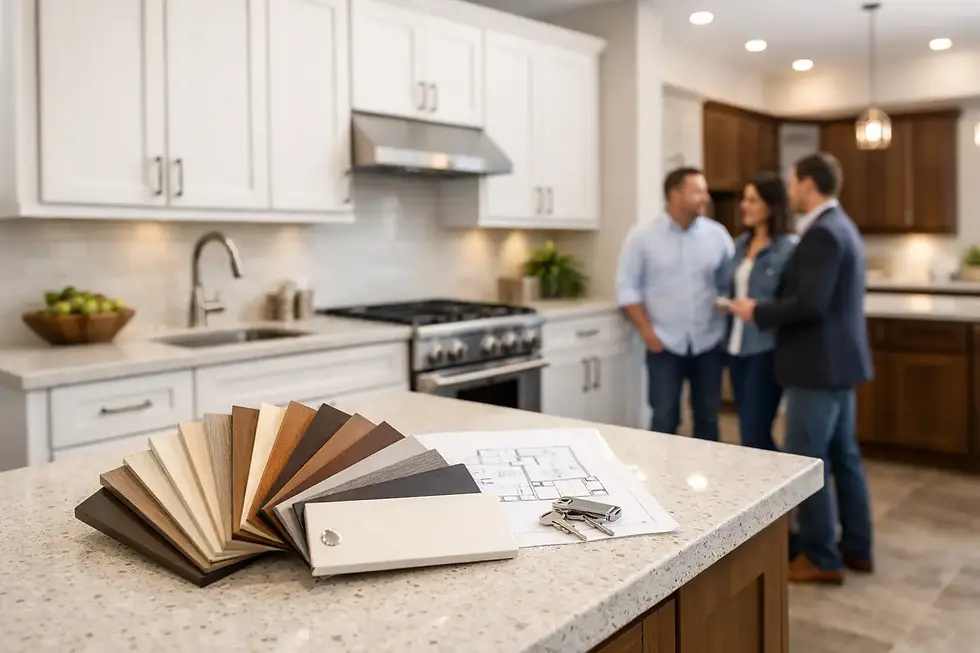
Countertops should also work with the cabinets rather than compete with them. Warm wood-tone cabinets often pair well with creamy whites, soft taupes, or natural stone patterns. Crisp white or gray cabinets can support bolder veining, charcoal tones, or a darker island surface. There is no one right combination, but samples should always be viewed together in the actual room whenever possible.
Popular Kitchen Countertops and Their Trade-Offs
Every material has strengths. The goal is not to find a perfect surface, because none exists. It is to choose the right trade-offs for your project.
Quartz: Consistent, Low-Maintenance Style
Quartz remains a popular choice for busy kitchens because it is nonporous, easy to clean, and available in a wide range of colors and patterns. It can create the look of soft marble veining, concrete, clean white stone, or a more subtle solid finish without requiring routine sealing.
For most homeowners, quartz is a practical fit for everyday food prep and family use. Still, it is not indestructible. Use trivets for very hot cookware, and avoid exposing it to intense direct heat. This matters in Arizona homes with bright windows near a countertop edge or outdoor-adjacent serving area. Quartz is best used indoors and should be protected from prolonged UV exposure that can affect some colors over time.
Granite: Natural Character and Heat Resistance
Granite brings genuine variation to a kitchen. No two slabs are exactly alike, which is part of its appeal. It handles heat well and can be an excellent choice for homeowners who want a natural material with depth, movement, and a one-of-a-kind look.
The trade-off is maintenance. Granite should be sealed as recommended to help resist staining, and its pattern can be more visually active than engineered materials. Selecting the actual slab is especially valuable with granite, since a small sample cannot show the full range of color and veining.
Porcelain: A Strong Option for Modern Kitchens
Porcelain slabs have become an appealing option for clean, contemporary kitchens. They are highly resistant to heat, scratches, stains, and UV exposure, making them worth considering for homeowners who want an indoor-outdoor visual connection or a surface near strong natural light.
Porcelain fabrication requires experience because the material is durable but can be challenging to cut and handle correctly. Edge details may also look different from the thicker profiles commonly seen with quartz or granite. It is a material where professional measuring, fabrication coordination, and installation make a real difference.
Laminate: Budget-Friendly With Better Looks Than Before
Laminate has come a long way. Modern options can mimic stone, wood, and concrete finishes at a lower price point, making laminate useful for rental properties, secondary kitchens, laundry rooms, or remodels where budget needs to stay focused on cabinets and layout.
It does have limits. Laminate is more vulnerable to cuts, heat, and moisture intrusion at damaged seams or edges. It can be a smart value choice, but it needs realistic expectations and careful daily use.
Butcher Block and Solid Surface: Best for Specific Priorities
Butcher block adds warmth that stone cannot replicate, particularly as an accent on an island or baking station. It does require regular care and protection from standing water. Many homeowners prefer it in a smaller area rather than across the entire kitchen.
Solid surface materials offer a smooth appearance and can often be repaired if scratched or damaged. They are a good fit for certain designs, though they generally do not provide the same heat resistance or natural visual depth as granite, quartz, or porcelain.
Plan Countertops With Cabinets, Not After Them
A countertop is only as functional as the layout beneath it. Cabinet dimensions determine the island footprint, sink base size, appliance clearances, and how much usable prep area you will have. That is why a countertop selection should happen alongside cabinet planning, not as an afterthought.
For example, a farmhouse sink, undermount sink, or workstation sink may require a specific cabinet configuration and countertop cutout. A cooktop needs proper clearance and support. If you want a waterfall edge at the island, cabinet placement and slab layout need to be planned early so the finished lines look intentional.
This is also the right time to decide on the details that make a kitchen feel custom: countertop thickness, eased or beveled edges, full-height backsplash material, overhang depth, and whether the island should contrast with the perimeter countertops. These are not minor finishing choices. They affect cost, fabrication, installation time, and the overall look of the room.
Measure at the Right Point in the Project
Accurate measurements are nonnegotiable, but countertop templating should happen after the base cabinets are installed, leveled, and secured. Measuring too early can create problems if cabinet positions shift even slightly during installation.
A well-managed project follows a practical sequence: confirm the room dimensions, build the cabinet layout in 3D, select cabinet finishes and countertop direction, install the cabinets, then complete final countertop measurements for fabrication. This process gives homeowners a clearer picture before ordering while protecting the accuracy required for final cuts, sink openings, seams, and backsplash alignment.
At Croc Kitchen Cabinets, that coordinated approach helps keep cabinet and countertop decisions connected from the first layout through professional installation. It is especially helpful for first-time remodelers who do not want to manage separate suppliers, installers, and measurements on their own.
Make Color and Pattern Decisions in Real Light
Showroom lighting is useful, but it is not your kitchen. Take samples home when possible and look at them in morning light, afternoon sun, and evening artificial light. A bright white countertop can read cooler or warmer depending on nearby cabinet paint, wall color, flooring, and backsplash tile.
Be cautious with very busy patterns if the kitchen already has patterned flooring, bold cabinet grain, or a detailed backsplash. On the other hand, a simple cabinet door can be a strong backdrop for a countertop with more movement. The most successful kitchens usually give the eye one clear focal point rather than asking every finish to stand out.
For a large slab with pronounced veining, ask how the pattern will run across the island and where seams may be necessary. Good planning can make seams far less noticeable, but no installer can eliminate the physical limits of slab size and room geometry.
Budget for the Complete Countertop Scope
The advertised price of a material is only one part of the cost. Fabrication, sink cutouts, cooktop cutouts, edge profiles, backsplash pieces, seam placement, removal of existing surfaces, and installation can all affect the final quote. A lower-cost slab may not remain the lower-cost option once specialty details are added.
It helps to compare complete project pricing rather than comparing material samples alone. Ask what is included, what needs to be prepared before installation, and how plumbing reconnection will be handled after the sink is installed. Clear answers upfront make the schedule easier to manage.
A kitchen should feel good to use long after the remodel is complete. Choose a countertop you will be comfortable cleaning, living with, and looking at every morning. When the material, cabinet layout, and installation plan are handled together, the finished space has a better chance of feeling like it was designed for your home rather than assembled from separate decisions.


Comments